Verified decision-makers in the source campaign account.
A displayed reply rate of 3.48% across contacted prospects.
15.4% of replies moved into the case study's opportunity stage.
Potential value at approximately $3,000 per recorded opportunity.
This is Ink Persuasion's own cold email pipeline case study. We were the operator and the client: our team defined the ICP, sourced and verified the list, prepared the sending infrastructure, wrote the sequences, managed replies, and recorded the opportunity handoff.
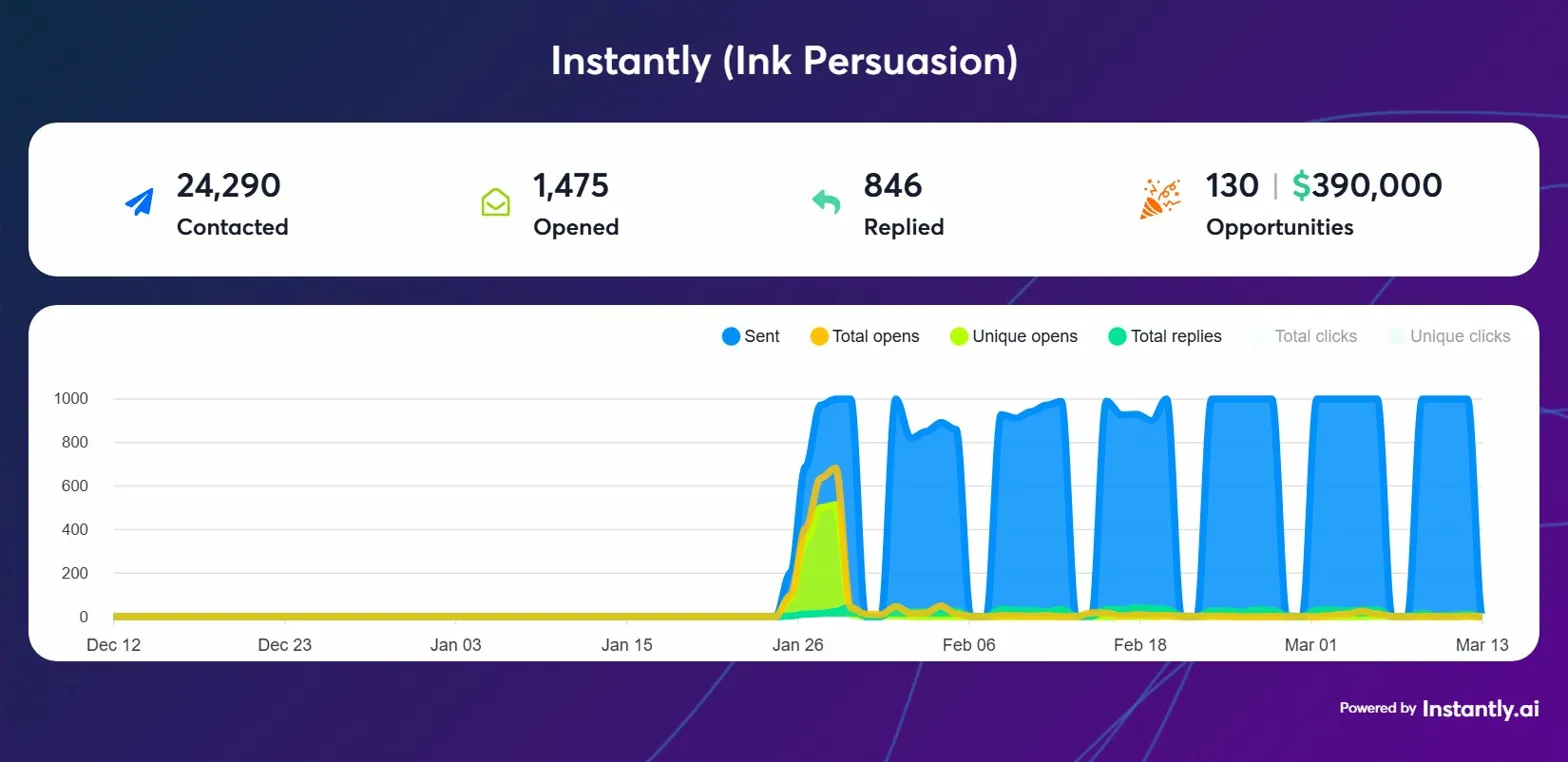
The dashboard graphic is the strongest evidence. It shows the result and the reporting window. The internal source document adds operating context, but this article separates what the dashboard directly shows from what the campaign team reported.
What the Instantly evidence shows
The original campaign graphic reports 24,290 contacted prospects, 1,475 tracked opens, 846 replies, 130 opportunities, and $390,000 in pipeline value. The date axis covers December 12, 2025 through March 13, 2026.
Visible send activity is concentrated from late January through March. The source document describes the earlier portion of the window as infrastructure preparation and warmup. That distinction matters because a 13-week reporting window is not the same as 13 weeks at peak sending volume.
How the $390,000 pipeline figure was calculated
The source case study assigns an average potential value of about $3,000 to each recorded opportunity:
130 recorded opportunities
x approximately $3,000
= $390,000
Instantly's current help documentation says its analytics count leads with positive statuses as opportunities. Those statuses include Interested, Booked Meeting, Completed Meeting, Closed, and positive custom statuses. It also warns that historical analytics can retain leads that were once marked positive even if their status later changed or the lead was deleted.
That is why this article uses recorded pipeline, not revenue. The number measures potential value inside the opportunity model. It does not prove that $390,000 was contracted, collected, or closed-won.
The five operating layers behind the result
1. Sending infrastructure before prospecting
The source campaign used dedicated sending domains and multiple mailboxes, configured with SPF, DKIM, and DMARC before scaling. Google currently requires SPF or DKIM for all senders to personal Gmail accounts and SPF, DKIM, and DMARC for bulk senders. Google also recommends slow, consistent volume increases and monitoring server responses, spam rate, and domain reputation.
2. A verified and segmented audience
The 24,290 contacts were sourced through Apollo and LinkedIn Sales Navigator, then segmented by industry, company size, and decision-maker seniority. The useful principle is not the tool name. It is that the list was built from an explicit ICP and verified before sequence import.
3. Problem-first copy
The first-touch emails stayed under 80 words and opened on the prospect's likely problem rather than a service description. Follow-ups added context while keeping the requested action to a reply. The source sequence used no links or attachments in the first touch.
4. Controlled execution
The graph shows weekday sending blocks, pauses, and a controlled ceiling near 1,000 sends on active days. A useful outbound system protects the infrastructure while preserving enough consistency to evaluate the audience and message.
5. Daily opportunity handling
Replies were reviewed and categorized rather than treated as one blended success metric. Positive replies moved to handoff, neutral replies could enter nurture, and negative replies were removed. The source reports that 130 of 846 replies became opportunities, a 15.4% reply-to-opportunity conversion.
What this cold email pipeline case study proves
- A managed cold email system can create a measurable opportunity pipeline over a sustained reporting window.
- The campaign recorded enough volume to inspect the full funnel rather than one small launch burst.
- The opportunity count and assigned value are visible together, so the pipeline math can be checked.
- Ink Persuasion operated this campaign for its own agency account rather than analyzing a third party's workspace.
What the evidence does not prove
- It does not establish $390,000 in closed-won revenue or cash collected.
- It does not show the exact number of meetings, proposals, or signed customers.
- It does not isolate which segment, subject line, or message variant created each opportunity.
- It does not guarantee that another offer, market, list, or sending setup will reproduce the result.
- It does not make tracked opens a reliable business outcome. Replies and opportunity progression carry more weight.
The useful claim is not "cold email always creates $390K." The useful claim is that one documented system moved 24,290 contacted prospects into 846 replies and 130 recorded opportunities, with the value model shown.
Frequently asked questions
Can cold email generate a predictable pipeline?
It can produce a measurable opportunity flow when list quality, sending infrastructure, copy, cadence, and reply handling remain stable enough to evaluate. Predictable means the inputs and conversion stages are visible. It does not mean outcomes are guaranteed.
Is a 3.48% reply rate good?
A reply rate cannot be judged without the audience, offer, time period, and reply definition. In this case, the more useful downstream number is that 130 of 846 replies became recorded opportunities.
Is pipeline the same as revenue?
No. Pipeline is potential value assigned to sales opportunities. Revenue requires a closed agreement and, depending on the reporting standard, payment or recognized revenue.
How does Instantly calculate opportunity value?
Instantly counts positive-status leads as opportunities and can apply a default value at the workspace or campaign level. Individual lead values can also be changed. Its historical analytics may retain previously positive leads, so operators should review the underlying CRM stages before presenting pipeline as revenue.
For a second managed example, read the $4M consulting-firm cold email case study. For a separate workspace analysis that is not presented as Ink Persuasion's campaign, see the $1.2M recorded pipeline analysis.