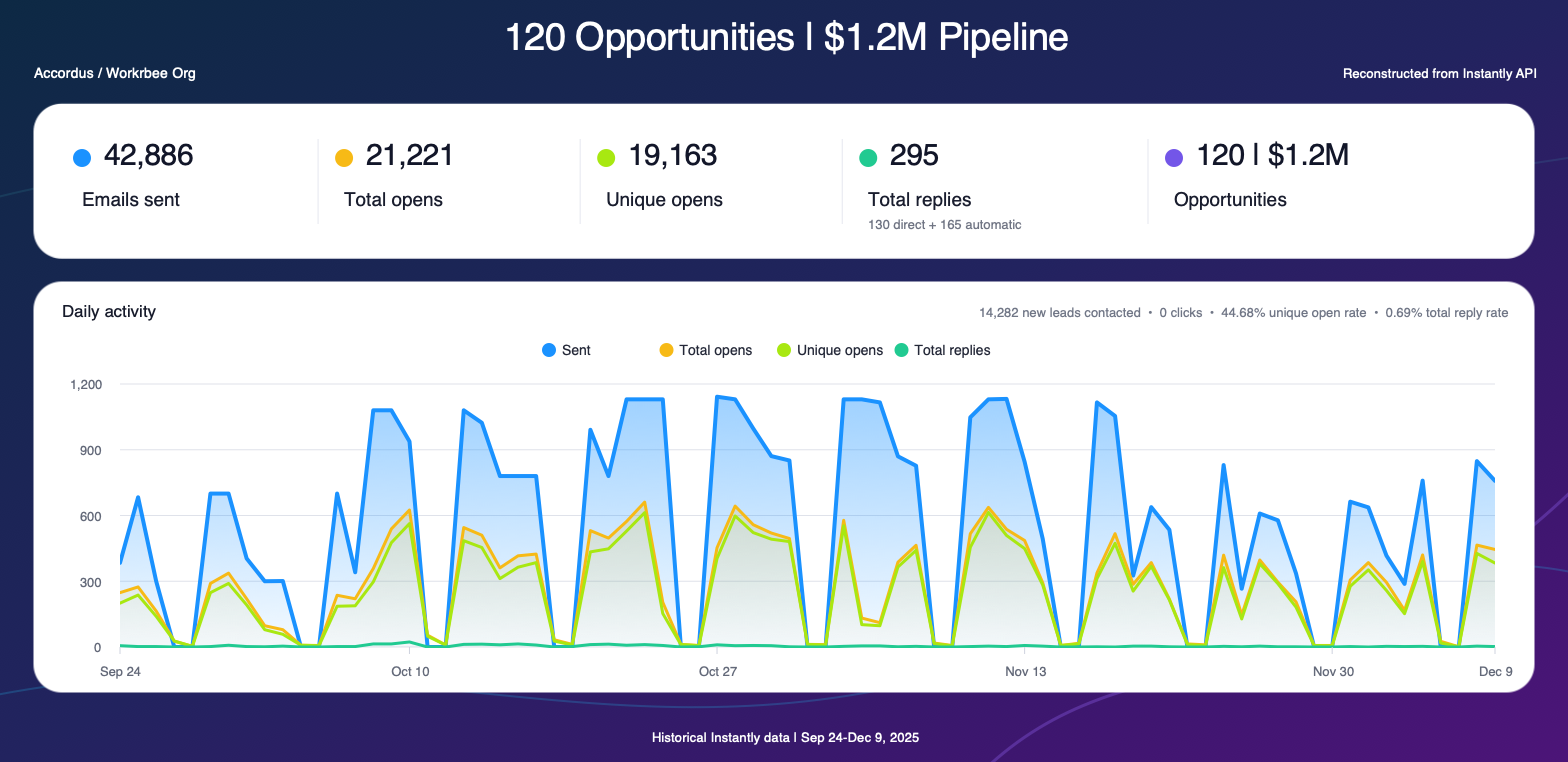
From September 24 to December 9, 2025, the Accordus / Workrbee Org workspace recorded 120 qualified or interested opportunities from 14,282 new leads across multiple cold email campaigns. At the workspace default of $10,000 per opportunity, the recorded pipeline value was $1,200,000.
This is a cold email lead generation case study about a workspace, not one perfect campaign. The numbers come from live Instantly historical analytics. The pipeline figure is potential value assigned to positive opportunities. It is not closed-won revenue, and the campaigns are not presented as Ink Persuasion's own work.
Cold email case study overview
A multi-campaign Instantly workspace, not a single campaign.
Eleven weeks of historical workspace analytics from 2025.
Activity, replies, and opportunities recorded in Instantly.
The configured default value used to calculate pipeline, not confirmed revenue.
How the cold email pipeline was calculated
The math is simple enough to audit:
120 recorded opportunities x $10,000 default value = $1,200,000
Instantly defines opportunities as leads assigned a positive status, such as Interested, Booked Meeting, Completed Meeting, Closed, or a positive custom status. Its documentation also explains that a workspace or campaign can assign a default monetary value to those opportunities. That is the mechanism behind the number here.
This distinction matters. A pipeline estimate helps an outbound team compare the potential value created by campaigns. It does not prove that every opportunity became a meeting, proposal, or closed customer.
The complete funnel, not just the headline
The workspace sent 42,886 emails and recorded 42,854 contacted events for 14,282 new leads. That works out to 3.00 contacted events per new lead across the period.
Instantly recorded 21,221 opens, including 19,163 unique opens. Unique opens were equal to 44.68% of emails sent. Tracked clicks were zero, so clicks are not used as supporting evidence in this case study.
The analytics separated 130 direct replies from 165 automatic replies. Direct replies represented 0.91% of new leads contacted. The 120 qualified or interested opportunities represented 0.84% of new leads.
What stands out in this B2B cold email lead generation result
1. The activity was sustained
The workspace averaged about 3,899 sent emails per week for eleven weeks. That is long enough to evaluate a multi-campaign operating period instead of highlighting a small early spike.
2. Automatic replies were not disguised as direct replies
Out-of-office messages and other automatic responses can inflate a blended reply rate. This snapshot reports the 165 automatic replies separately and uses the 130 direct replies for its direct-reply rate. The complete handling rules are in Automatic Replies Are Not Replies.
3. The pipeline math is visible
The case study does not imply that software independently verified $1.2M of closed revenue. It shows the opportunity count, the configured value, and the multiplication behind the pipeline total.
What this cold email outreach case study does not prove
- It does not show how the leads were sourced, verified, or segmented.
- It does not attribute every opportunity to one campaign, subject line, or sequence.
- It does not establish closed-won revenue, cash collected, or final conversion rate.
- It does not make tracked clicks useful evidence because the workspace recorded zero clicks.
- It does not mean the same rates will transfer to a different offer, market, list, or sender setup.
A useful case study should make the denominator and the uncertainty visible. The headline earns attention. The definitions decide whether the result is trustworthy.
What is cold email lead generation?
Cold email lead generation is the process of identifying relevant business prospects, contacting them by email, and turning positive responses into qualified sales opportunities. A complete system includes the ideal customer profile, list building, verification, sending domains, authentication, inbox monitoring, copy, reply handling, and pipeline tracking.
The channel is not just a script. Google requires senders to authenticate mail, maintain valid DNS, send over TLS, use accurate message elements, and keep spam rates low. That infrastructure work belongs beside the campaign strategy, which is why Ink Persuasion uses a formal cold email pre-send QA checklist before launch.
How to choose a cold email lead generation agency
Ask a potential cold email lead generation agency to show more than a revenue headline. A useful review should answer five questions:
- What period and campaign scope does the result cover?
- How many new leads received outreach?
- Are automatic replies separated from direct replies?
- What status qualifies as an opportunity?
- Is the stated value pipeline, closed revenue, or collected cash?
Also ask how the agency handles verification, recipient gateways, mailbox health, and provider-specific placement. Our guides to Microsoft 365 versus Gmail deliverability and deliverability recovery show the operational standard behind the campaign layer.
Can cold email create a predictable pipeline?
It can create a measurable opportunity flow when the list, offer, infrastructure, copy, and follow-up process remain stable enough to evaluate. Predictable does not mean guaranteed. It means the team can see how many leads entered, how many valid responses emerged, how opportunities were classified, and how potential value was assigned.
This eleven-week snapshot is useful because it exposes that chain. The result is not merely "$1.2M from cold email." It is 14,282 new leads, 130 direct replies, 120 positive opportunities, and a $10,000 configured value applied consistently across the workspace.
For two managed campaign examples with original Instantly graphics, compare Ink Persuasion's $390K internal cold email pipeline case study and the anonymized $4M consulting-firm cold email case study. Those pages use separate search intents and keep pipeline distinct from closed revenue.