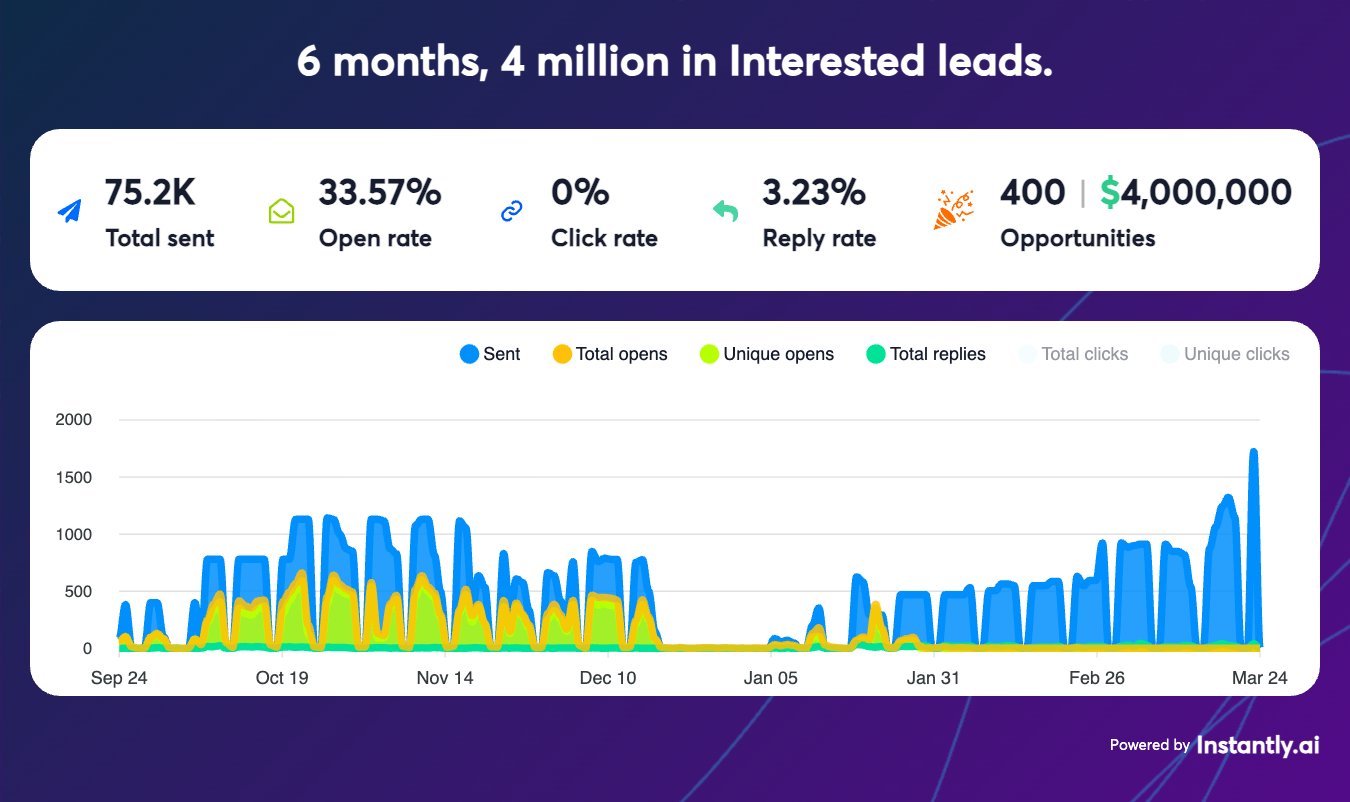
Sent across a six-month reporting window.
Approximately 2,429 replies when derived from the rounded rate.
Classified as opportunities in the source dashboard.
Potential value at approximately $10,000 per opportunity.
This campaign ran for an anonymized consulting and professional services firm with an average potential engagement value of about $10,000. Ink Persuasion built the outbound infrastructure, sourced and validated the audience, wrote the sequences, tested message variants, and managed reply qualification.
The source client remains anonymous. The campaign evidence does not. The original Instantly graphic reports 75.2K emails sent, a 33.57% tracked open rate, a 0% click rate, a 3.23% reply rate, 400 opportunities, and $4,000,000 in recorded pipeline.
Cold email for consulting firms: the campaign context
The consulting firm previously relied on referrals, speaking engagements, and inbound demand. That can produce high-quality work, but it is difficult to forecast because the business does not control when the next introduction arrives.
The outbound brief had three parts: build dedicated sending infrastructure, identify decision-makers with a plausible need for the advisory offer, and create messages that could earn a conversation without trying to explain an entire consulting methodology in the inbox.
The campaign ran from September 24, 2025 through March 24, 2026. The graph shows sustained sending in the first phase, a pause around late December, and a second phase that increased volume into March.
The complete consulting lead generation funnel
The displayed 3.23% reply rate implies approximately 2,429 replies from 75,200 sent emails. That number is a calculation from a rounded dashboard rate, not a separately reported provider count. The source case study then records 400 interested leads, which is about 16.5% of the estimated replies.
How the $4 million pipeline figure was calculated
400 recorded opportunities
x approximately $10,000
= $4,000,000
The source case study describes these 400 records as interested leads. The graphic labels them as opportunities. Instantly's current documentation defines opportunities as leads assigned a positive status, including Interested, Booked Meeting, Completed Meeting, Closed, or a positive custom status.
That product definition is broader than closed business. Instantly also says historical analytics include leads that were ever marked positive, even if a status later changed or a lead was deleted. The $4M figure should therefore be read as potential pipeline recorded in the campaign model, not as verified revenue.
Why consulting cold email needs a different message
Consulting is a high-trust sale. Buyers are not choosing a simple product specification. They are deciding whether another person understands a difficult business problem well enough to guide a consequential decision.
The campaign's first-touch messages stayed under 80 words and opened on the business problem, not the consultant's methodology. They avoided a credentials dump, attachments, links, and calendar requests. Follow-ups introduced outcome-based credibility only after the first message established relevance.
This sequencing matters because a cold email does not need to close a $10,000 engagement. Its job is to earn the next conversation with the right person.
The five operating layers behind the campaign
1. Multi-domain sending infrastructure
The campaign used multiple domains and mailboxes to distribute volume across a six-month run. Authentication and slow volume increases matter. Google's current sender guidelines require SPF or DKIM for all senders to personal Gmail accounts, with SPF, DKIM, and DMARC required for bulk senders.
2. ICP-matched lead sourcing
The source workflow matched company revenue bands, growth signals, and senior titles such as founders, CEOs, COOs, and relevant vice presidents. Each record was validated before sequence import. Broad title scraping would have increased volume while reducing the chance that the problem was timely.
3. Consulting-native copy
The first message named a business problem and asked for a low-friction reply. It did not try to sell the full engagement. That kept the copy focused on recognition: does this person have the problem, and do they want to discuss it?
4. Continuous message testing
Subject lines and opening lines were tested across audience segments. Winning variants received more volume and weak variants were stopped. The point of a test is not novelty. It is a clear decision rule attached to one meaningful variable.
5. Daily reply qualification
Replies were reviewed, categorized, and routed. Positive responses were escalated, neutral responses could enter nurture, and negative responses were removed. This is the operational step that turns a reply metric into a sales pipeline.
What the campaign evidence proves
- A consulting offer can generate sustained cold email engagement when the audience and problem are specific.
- The campaign maintained a 3.23% displayed reply rate across 75,200 sent emails over six months.
- The source system recorded 400 interested leads or opportunities and assigned approximately $10,000 to each.
- The original dashboard graphic exposes the send pattern, dates, and headline metrics instead of asking readers to trust a text-only claim.
What the campaign evidence does not prove
- It does not prove $4 million in closed-won revenue or collected cash.
- It does not disclose the client's identity, exact service, lead list, or message copy.
- It does not show how many interested leads became meetings, proposals, or customers.
- It does not make the 33.57% tracked open rate a business outcome. Opens are a diagnostic signal, while replies and opportunity progression matter more.
- It does not guarantee the same result for a different consulting offer, market, list, or sender environment.
Compliance and deliverability still set the boundary
U.S. CAN-SPAM rules apply to business-to-business commercial email. The Federal Trade Commission requires accurate header information, non-deceptive subject lines, a valid postal address, a clear opt-out mechanism, and timely handling of opt-out requests. The company hiring an outbound provider cannot contract away its responsibility.
Legal compliance is only the floor. Google's sender guidance also emphasizes authentication, truthful message elements, consistent volume, low spam complaints, and easy unsubscribe. A technically legal campaign can still lose inbox placement if recipients do not want the messages.
Before scaling, use a documented cold email pre-send QA checklist and monitor provider-specific placement rather than trusting one seed inbox.
Frequently asked questions
Does cold email work for consulting firms?
It can work when the offer solves a recognizable problem, the audience is narrow enough to identify that problem, and the first message asks for a conversation rather than attempting to sell the engagement. This campaign is one documented example, not a universal benchmark.
How do you sell consulting without explaining the methodology?
Use the cold email to establish relevance and earn a reply. The sales conversation can then cover diagnosis, credibility, process, and fit. Trying to compress the entire methodology into the first touch usually creates a long, sender-centered message.
Is the $4 million figure revenue?
No. It is recorded pipeline: 400 positive opportunities multiplied by an approximate $10,000 potential value. Closed-won revenue requires a separate CRM and financial reconciliation.
What should a consulting firm measure?
Track valid delivery, direct replies, positive replies, qualified opportunities, meetings, proposals, wins, and collected revenue as separate stages. Define each stage before launch so one broad "interested" label does not hide the true conversion path.
For an internal agency campaign with a different value model, read the $390K cold email pipeline case study. For a separate multi-campaign workspace analysis, see the $1.2M recorded pipeline case study.